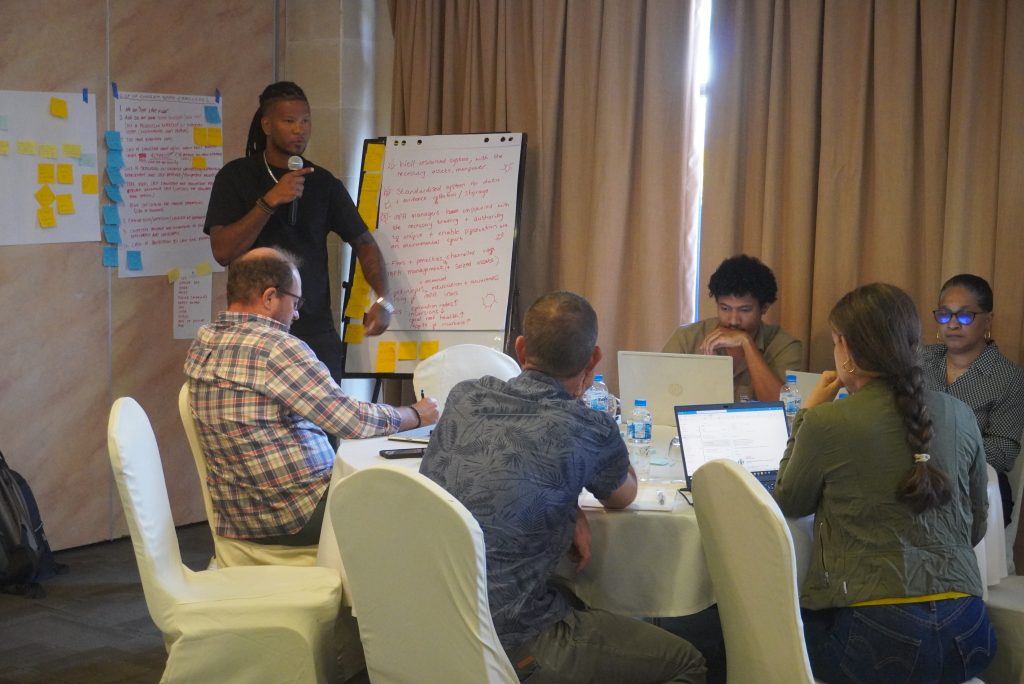
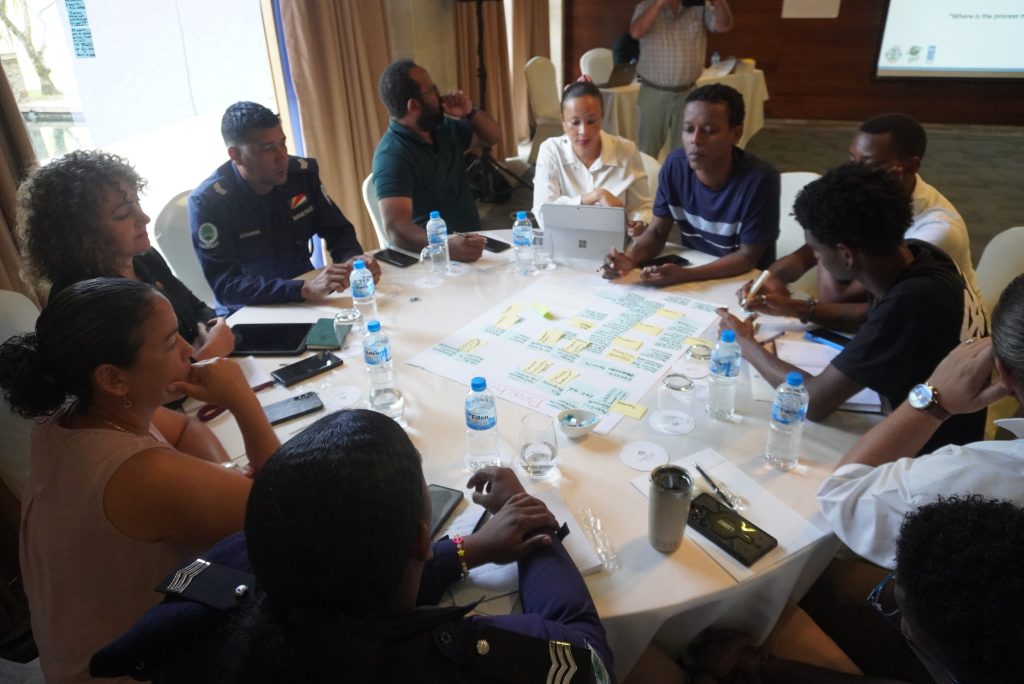
Held from 15–17 September at the Savoy Seychelles Resort & Spa, a cross-agency value stream analysis workshopfocused on Strengthening Cross-Agency Environmental Enforcement Coordination in Seychelles’ Marine Protected Areas, brought together operational and supervisory personnel from key government agencies, enforcement authorities and marine conservation organisations involved in marine monitoring, compliance, enforcement, investigations and prosecution.
The initiative was supported by the GOS-GEF-UNDP Blue Economy Project, Prioritising Biodiversity Conservation and Nature-based Solutions as Pillars of Seychelles’ Blue Economy, implemented by the Ministry of Environment, Climate, Energy and Natural Resources (MECENR), with technical leadership from NLA International. The initiative brought together a team of international and national experts in marine management, environmental enforcement and organisational transformation.
Seychelles’ expanded Marine Protected Area network and the promulgation of the Seychelles Marine Spatial Plan have created and expanded responsibilities across a range of institutions. While individual agencies have developed capacity within their respective mandates, effective coordination between organisations remains essential to ensuring that environmental offences and violations are addressed efficiently and consistently.
Opening the workshop, Principal Secretary for the Department of Environment and Natural Resources, Nanette Laure, highlighted that protecting Seychelles’ marine environment is not only an environmental responsibility, but an important part of the country’s national development agenda, economy, livelihoods and long-term sustainability.
PS Laure emphasised that effective enforcement cannot be achieved by any single institution working in isolation.
Marine environmental incidents can involve several stages and jurisdictions, with one institution potentially detecting an incident, another responding, another undertaking an investigation, and others becoming involved in prosecution or follow-up.
Ensuring that these different actions connect effectively is therefore critical to the overall strength of the enforcement system.
“The strength of our environmental enforcement system should be measured not only by the capacity of individual agencies, but by how effectively those agencies are able to work together as a whole,” stated Laure.
Mapping the enforcement process from detection to prosecution
Rather than focusing solely on individual institutional mandates, the workshop used a participatory Value Stream Analysis approach to examine how environmental enforcement processes currently operate in practice.
Over the three days, participants mapped enforcement processes from the initial detection or reporting of an incident through response, investigation and prosecution. This allowed frontline practitioners and supervisory personnel to examine the system collectively, identify operational realities and highlight where communication, coordination or procedures may create delays or gaps.
Participants then considered what a more effective future enforcement system could look like, before undertaking a gap analysis and identifying practical actions to help move from the current state towards the desired future state.
The approach placed particular emphasis on practitioner-led problem solving, with participants exploring a range of potential solutions that were realistic, ambitious, locally appropriate and capable of being sustained within existing or anticipated resources. The exercise also sought to identify solutions that may require additional resources, investment or institutional support to be taken forward.
The workshop brought together representatives from the Department of Environment and Natural Resources, Seychelles Fisheries Authority, Seychelles Maritime Safety Authority, Seychelles Ports Authority, Seychelles Police Force including the Marine Police and Criminal Investigative Division, Seychelles Coast Guard, Attorney General’s Office, Seychelles Marine Spatial Planning Authority, Seychelles Parks and Gardens Authority, Island Conservation Society, Marine Conservation Society Seychelles, Seychelles Islands Foundation, Nature Seychelles, Indian Ocean Tortoise Alliance and Island Biodiversity Centre.
Identifying common gaps and practical solutions
By the conclusion of the workshop, participants had developed a shared understanding of a number of challenges affecting environmental enforcement and identified priority areas for improvement.
Common themes emerging from the discussions included the need for clearer standard operating procedures for environmental crimes, stronger coordination mechanisms between agencies, clearer communication channels and focal points, improved information-sharing, appropriate training for future authorised officers, and strengthened public engagement and education.
Participants also highlighted the importance of stronger follow-up and continuity throughout the different stages of an enforcement process, so that incidents do not lose momentum as responsibility moves between institutions, and relevant officers remain informed, engaged and connected to the process through to its conclusion.
The discussions resulted in a series of proposed actions and solutions to address the identified gaps over the short, medium and longer term.
These proposed actions will be consolidated and presented to the senior management of relevant agencies, including those identified as critical decision-makers, with the aim of supporting their consideration and implementation.
Some of the proposed actions will also be supported directly through the GOS-GEF-UNDP Blue Economy Project.
The workshop outcomes will further contribute to the development of a Standard Operating Procedures Framework for Marine Environmental Crimes under the Blue Economy Project. The workshop concept specifically identifies the exercise as an important input into the development of this framework.
From workshop discussions to implementation
Closing the workshop, Project Manager of the GEF7 Blue Economy Project, Victoria Alis, thanked participants for their openness, active engagement and willingness to look beyond their individual institutional responsibilities.
She noted that one of the most valuable aspects of the workshop had been bringing such a diverse group of practitioners around the same table and creating an opportunity to examine the entire enforcement chain collectively.
The discussions demonstrated that strengthening environmental enforcement is not simply about increasing the capacity of individual agencies, but also about strengthening the connections between them.
The next step will be to consolidate the workshop outcomes into a prioritised action plan, which will subsequently be brought to relevant senior management representatives identified as critical decision-makers, including those who were unable to participate in the three-day session.
“We do not want this to end with a workshop report or a set of actions on paper. The real test will be what we do with what we have discussed here,” stated Alis.
The workshop forms part of broader efforts under the GEF7 Blue Economy Project to strengthen the implementation of marine management measures and support more effective monitoring, control, surveillance and environmental enforcement in Seychelles.
The three-day exercise therefore marks a step towards building a more connected enforcement system - one where institutional mandates remain clear, while information, responsibilities and action can flow more effectively across agencies.
Ultimately, protecting Seychelles’ marine environment is a shared responsibility, requiring not only strong policies and institutions, but also the cooperation and collective commitment needed to translate those frameworks into effective action on the ground.